Building a reliable audio setup when rehearsing in an unequipped space and playing at different venues every week presents a practical challenge: the gear needs to be portable, compatible with what’s available on site, and versatile enough to cover two distinct uses.
Choosing audio equipment for concerts and rehearsals isn’t just about power. It also involves connector compatibility, the system’s weight, and how well it can integrate into a sound chain you may not always control.
Portable audio equipment: fixed vs. modular setups
The first major decision for a band is the format of its system. Buying a complete package (speakers, mixer, cables) may seem like the obvious choice, but it locks you into a fixed setup. Choosing separate components that work together offers greater flexibility, but requires some research beforehand.
| Criterion | Complete package (fixed) | Modular setup |
|---|---|---|
| Transport | Heavy, one load to carry | Can be split between several band members |
| Venue compatibility | Low (connectors are fixed) | High (choice of interfaces and cables) |
| Expandability | Limited to the original package | Modules can be added over time |
| Initial cost | Often lower | Varies depending on choices |
| Setup time | Short (everything is included) | Longer (checks are required) |
For a band that alternates between rehearsals in a garage and gigs in bars or community halls, a modular setup reduces compatibility issues with equipment already available at the venue. If the venue provides front-of-house speakers, you only need to bring your mixer and microphones. If it doesn’t provide anything, you can add your own powered speakers.
A professional equipment catalog makes it easier to compare options before committing: https://www.backline.fr lists equipment used in real-world live settings, helping you identify industry standards.
Powered or passive speakers: a choice that shapes the entire sound system
Competitors often approach this question in terms of power. For a touring band, the real considerations are different: the number of cables, total weight, and reliance on an external amplifier.
A powered speaker has a built-in amplifier. It connects directly to the mixer output, so there’s no separate amp to carry and no impedance calculations to check. For a four-piece band loading its gear into a van, two compact powered speakers cover most situations for audiences of up to around 100 people.
A passive speaker requires a dedicated amplifier and specific cabling. It offers more flexibility when choosing an amp and allows for custom setups. This format is better suited to bands that regularly play the same venue or have access to a sound engineer.
- For rehearsals, two low-powered speakers are enough to balance vocals and acoustic instruments without making the room too loud
- For a gig in a bar (fewer than 100 people), the same pair of powered speakers can serve as the front-of-house system, with a floor monitor added for the singers
- At a community hall or festival, the front-of-house system is generally provided, so the band only needs its mixer, microphones, and, if necessary, monitors
Mixers for rehearsals and concerts: analog or digital
Your choice of mixer affects setup time and compatibility with venue sound desks. An eight-input analog mixer remains the most common option for a small band. It requires no software configuration, can be connected in minutes, and works with any speaker.
Compact digital mixers offer additional features, including built-in effects, saved settings, and multiple outputs. Saving your settings means you don’t have to reconfigure everything each time you play a different venue. One point to check is network protocol compatibility.
An industry article on live consoles describes how Dante, AES67, and ST 2110 coexist, with differences in interoperability and synchronization. A networked system isn’t always necessary for rehearsals or small stages, but checking protocol compatibility becomes important if you plan to connect your mixer to an existing digital sound desk.
For a band just starting out with live shows, a reliable analog mixer covers the essentials without unnecessary complexity. Investing in a digital console makes sense as the number of gigs increases and soundcheck time becomes more limited.
Sound levels and regulations: a technical factor to plan for
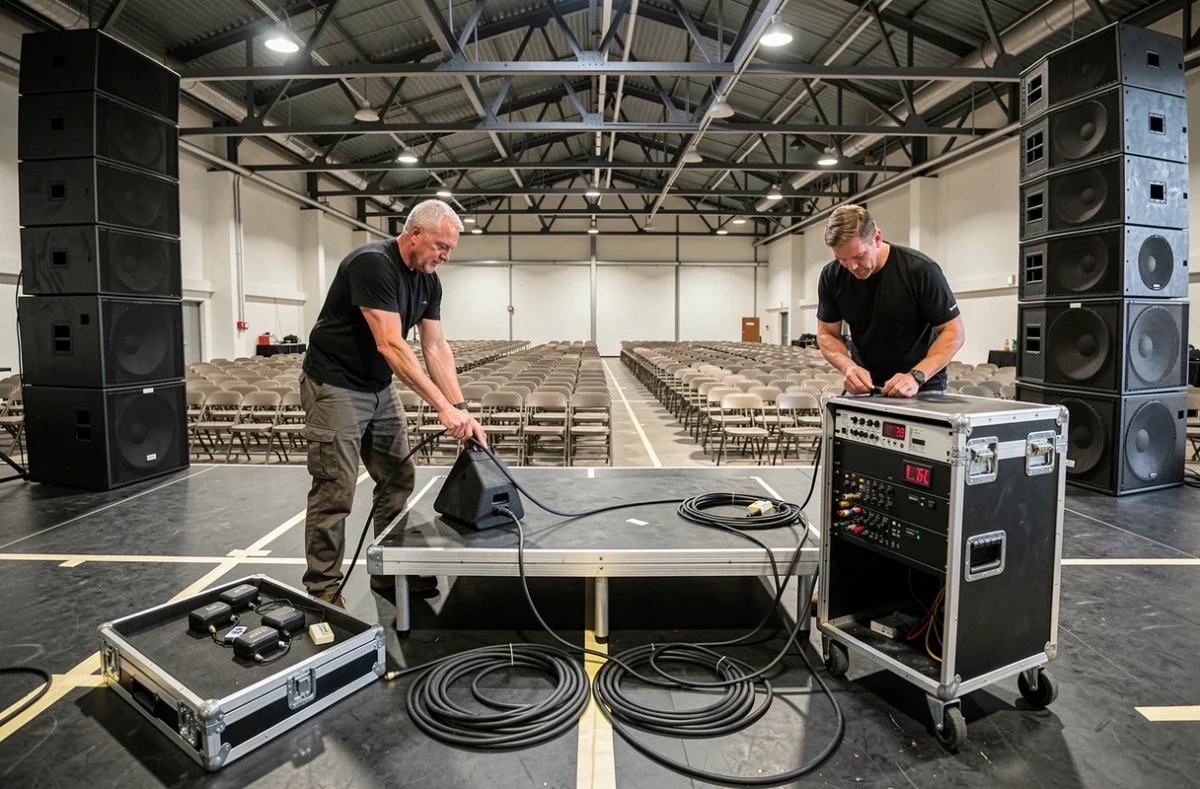
French regulations set limits on sound levels in venues playing amplified music. They require venues to inform the public, provide free hearing protection, and designate areas or periods for auditory rest. Venues with a capacity of more than 300 people must continuously record and display sound levels.
For concerts aimed at young children (up to and including six years old), sound limits are lower. This requires a specific setup: lower-powered speakers, a calibrated limiter, and appropriate speaker placement.
These requirements influence equipment choices. A limiter built into the audio chain helps you stay compliant without having to monitor the volume constantly. Some newer powered speakers include this feature. For bands playing venues of different sizes, a portable sound level meter helps check levels before and during the set.
- Check with the venue to see whether a limiter is already installed on the front-of-house system
- Bring hearing protection to hand out if the venue doesn’t provide it
- Keep stage volume at a reasonable level during rehearsals to protect your hearing over the long term
Renting or buying audio equipment: deciding based on the number of gigs
The Better Live program, which organized 64 tours and 363 events across nine regional networks, illustrates the benefits of pooling resources: grouping several concerts in the same area can significantly reduce the carbon footprint of touring. The same approach applies to equipment. Renting front-of-house speakers for three dates in a row costs less than buying a system you’ll use four times a year.
Buying makes sense for the equipment you use every time: a mixer, microphones, cables, and stage monitors. Buy the core equipment and rent the extras to keep upfront costs down while maintaining a reliable setup you know well.
Rehearsal gear and concert gear aren’t two separate worlds. By choosing components with compatibility as a top priority, a band can gradually build a system that works anywhere, without relying on a fixed package or a single supplier.