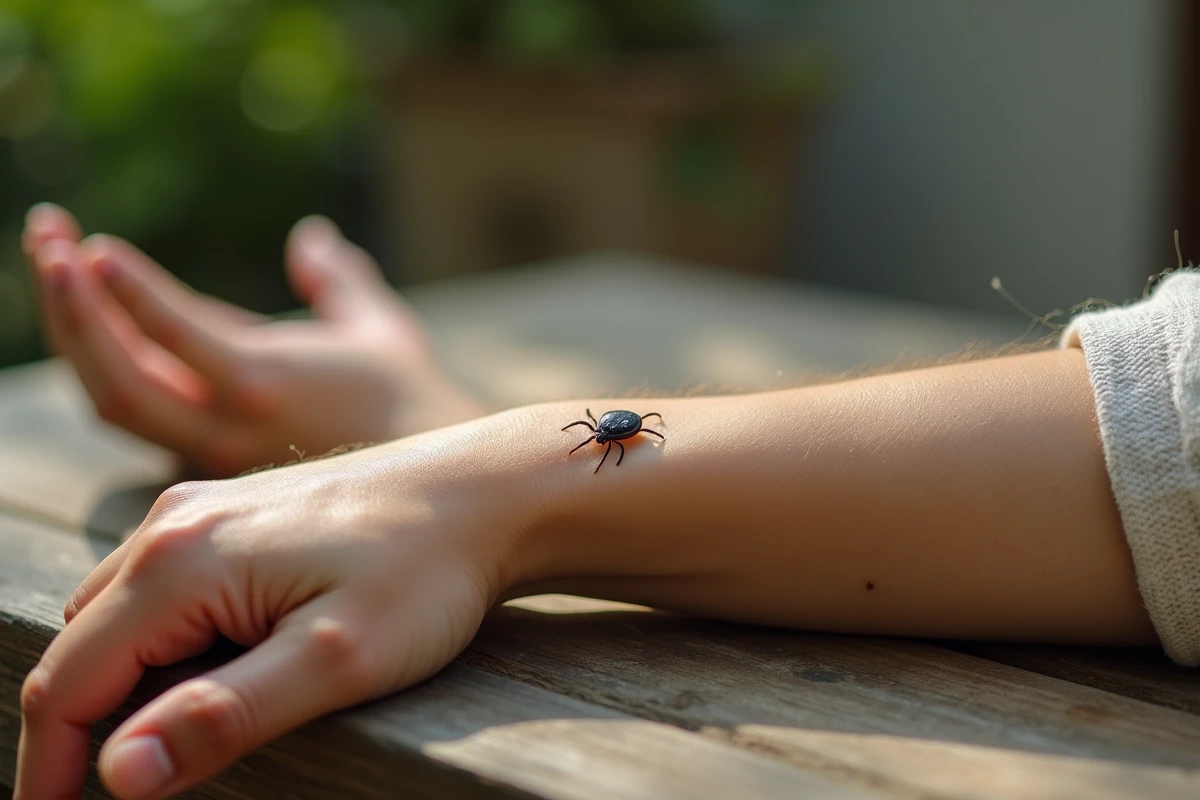
We’re in shorts in the garden, feeling an itch on the calf, and upon closer inspection, we discover a tiny black dot stuck to the skin. The first reflex is often to scratch or crush it. This is precisely what you should not do, because what happens next entirely depends on what is actually embedded there.
Tick attached, insect resting, or reaction without a critter: three situations, three actions
Most online content lists insects without distinguishing the case where the creature is embedded in the skin from the case where it is simply resting on top. This difference changes everything.
A tick burrows in with its mouthpart and does not move anymore. If you pull on it without the right tool, you risk leaving the head embedded in the skin. A thrips, on the other hand, rests for a few seconds, sometimes causing a micro-sting that irritates, then leaves. And in some cases, you may see a red bump or a black dot without any visible insect: this is a skin reaction to a sting that has already occurred, or even an ingrown hair.
When you spot a tiny black creature clinging to the skin, the first diagnosis to make is not “what insect is this,” but rather “is it still moving?” If the black dot remains still despite a puff of air, you are likely facing a tick. If it moves quickly, it is a passing insect.

Removing a tick attached to the skin: technique and common mistakes
In the field, many people still use ether, oil, or a match to “put the tick to sleep” before removing it. These methods are counterproductive. They stress the animal, which then regurgitates more saliva into the wound, increasing the risk of pathogen transmission.
The correct action with a tick remover
Slide the hook as close to the skin as possible, under the body of the tick. Gently twist without pulling, in a rotating motion. The tick will detach itself after a few turns. The longer the tick remains attached, the greater the risk, which is why it is important to act quickly.
If you don’t have a tick remover on hand, a fine pair of tweezers (like eyebrow tweezers) positioned close to the skin will do the trick. Pull perpendicularly, without crushing the body of the tick.
After removal
- Clean the area with soap and water, then disinfect with a standard antiseptic.
- Monitor the area for several weeks: the appearance of a red halo that expands (migratory erythema) warrants a quick consultation.
- Note the date of removal and the location of the sting, useful information if symptoms appear later.
Feedback varies on the duration of monitoring to be observed, but keeping an eye on the area for at least three weeks remains the most common recommendation.
Thrips and springtails: these black insects that rest without attaching
When the black creature on the skin measures barely one or two millimeters and moves, you are often facing a thrips. This tiny black or brown insect usually lives on plants. In hot and dry weather, it finds its way onto the skin, attracted by moisture or the color of light clothing.
The thrips can cause a micro-sting, felt as a sharp prick. The skin reaction remains local and benign. It is not a human parasite: it does not settle, does not lay eggs on the skin, and does not return by itself.
Springtails, even smaller, are sometimes confused with fleas. They jump, do not sting, and end up on the skin by accident. An insect that moves quickly and jumps is generally not a threat.

Warning signs after a sting from a tiny black creature
The majority of stings from small black insects cause local redness, slight swelling, and itching that disappears within a few days. You clean, monitor, and move on.
However, certain signs require immediate medical consultation:
- Swelling of the face or throat, even slight, within hours of the sting.
- Breathing difficulties, feeling of chest tightness.
- General malaise, dizziness, drop in blood pressure.
- Multiple grouped stings, especially in a child or a known allergic person.
- Appearance of a red circle that expands around the sting site in the following days or weeks (indicative sign of a tick-borne disease).
For an isolated sting with simple itching, cleaning with soap and water followed by an antiseptic is sufficient. Avoiding scratching limits the risk of superinfection.
Skin reaction without a visible insect: do not search for a critter at all costs
The frequency of this scenario is often underestimated. A red bump, a black dot, localized itching, and we search for an insect everywhere. Sometimes, there simply isn’t one, or anymore.
An ingrown hair, folliculitis, a small subcutaneous hematoma, or the trace of a mosquito that passed long ago can mimic the appearance of a creature stuck. If the black dot does not move, does not detach with a tick remover, and the surrounding skin is neither red nor swollen, you are probably not facing an insect.
The most useful reflex remains to observe with a magnifying glass or the phone camera in macro mode. Six legs or eight visible legs confirm an arthropod, while a simple dark dot without identifiable structure points towards a common skin lesion.